
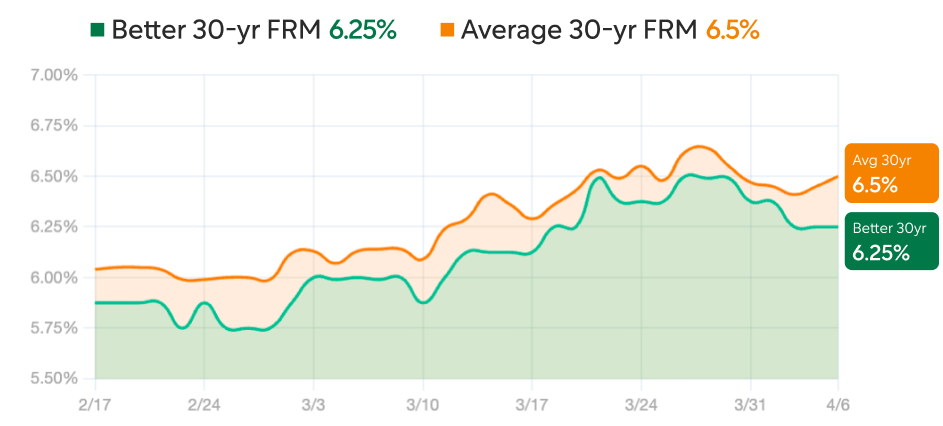
Rates are daily averages based on Better Mortgage data, not APRs, and vary by borrower.
On June 3, 2026, the average 30-year fixed mortgage rate is 6.57%, with the 15-year fixed at 6.10% and the 5/1 ARM at 6.54%.
Rates have edged slightly lower today as bond yields pulled back on renewed signals that U.S.–Iran ceasefire talks may resume, though geopolitical uncertainty remains elevated and current mortgage rates are still well above where they started the year.
Your actual rate will depend on your credit score, down payment, loan type, and lender.
Today's mortgage rates — June 3, 2026
| Loan type | Average rate |
|---|---|
| 30-year fixed | 6.57% |
| 15-year fixed | 6.10% |
| 5/1 ARM | 6.54% |
| 30-year fixed refinance | 6.76% |
| 15-year fixed refinance | 6.08% |
These are national averages. Your actual rate depends on your credit score, down payment, loan amount, and lender.
...in as little as 3 minutes — no credit impact
What's moving rates today
Mortgage rates have been caught in a push-pull for most of the spring, and today is a version of that pattern playing out in real time.
The primary driver of elevated rates in 2026 has been the U.S.–Iran conflict, which began in early March and has kept oil prices, and therefore inflation expectations, persistently high. When oil prices rise, inflation tends to follow, and when markets expect higher sustained inflation, they demand higher yields on long-term bonds to compensate. Since mortgage rates track the 10-year Treasury yield closely, anything that pushes that yield higher pushes mortgage rates higher alongside it.
Today, yields pulled back modestly after diplomatic signals suggested ceasefire negotiations between the U.S. and Iran may re-open. The 10-year Treasury, which had approached 4.5% earlier this week, retreated slightly, and that movement filtered through to mortgage pricing.
The relief is real but limited. Analysts tracking the conflict have noted that positive headlines have moved yields lower in the past, only for rates to climb again when talks stalled. This article covers the structural drivers in more detail if you want the full picture.
The other factor worth understanding: Federal Reserve policy. New Fed Chair Kevin Warsh, who took over in May 2026, has signaled a cautious approach to rate cuts, prioritizing inflation control over near-term stimulus. That stance keeps short-term borrowing costs anchored, which in turn keeps long-term mortgage rates from falling as quickly as many buyers had hoped. What determines mortgage rates walks through the full chain of influence from the Fed to your loan offer.
The practical read for borrowers: rates may dip on good geopolitical news and climb on bad news. That volatility is the environment right now. Planning around it means focusing on what you control, which includes your credit profile, your down payment, and your loan structure, more than trying to time the daily rate.
What today's rate means for your monthly payment
The rate itself matters less than what it translates to in dollars. Here's how the current 30-year fixed rate of 6.57% affects a principal and interest payment at three loan amounts:
| Loan amount | Est. monthly P&I at 6.57% |
|---|---|
| $300,000 | ~$1,913 |
| $400,000 | ~$2,550 |
| $500,000 | ~$3,188 |
Example is for illustrative purposes only. Figures represent principal and interest only and do not include property taxes, homeowners insurance, HOA fees, or private mortgage insurance. Rates, payments, and total interest will vary based on credit profile, loan terms, and market conditions.
For a more precise estimate based on your actual situation, use the mortgage calculator to input your specific loan amount, down payment, and credit range. That number will be closer to your real monthly cost than any national average can be.
...in as little as 3 minutes — no credit impact
Should you lock your rate today?
This is one of the most common questions buyers and refinancers ask, and it doesn't have a universal answer. It depends on your timeline, your risk tolerance, and what you believe is more likely: that rates fall before your closing, or that they hold or climb.
Here's the honest context for June 3, 2026: rates are currently being driven primarily by geopolitical events, which are unpredictable by nature. A credible, durable ceasefire in the Middle East would likely bring oil prices lower, reduce inflation expectations, and push yields, and therefore mortgage rates, down meaningfully. But those same expectations have appeared before and dissolved. Anyone waiting for that outcome is taking on headline risk in both directions.
If you have a closing in the next 30–45 days and the current rate works for your budget, locking provides certainty. Many lenders offer float-down options that allow you to lock a rate and then move to a lower rate should it drop materially before closing. It's worth asking your loan officer whether that's available to you if you want downside protection without fully floating.
If your closing is further out or you're still earlier in the homebuying process, monitoring the rate environment makes sense. Understanding how to shop around for mortgage rates can help you get multiple quotes when you're ready, rather than accepting the first offer you see.
How to get a lower rate than the average
The national average is a useful benchmark, but it doesn't determine your rate. Several factors under your control can move you above or below that number, sometimes by a meaningful margin.
Your credit score is the single biggest lever. The difference between a 680 and a 760 score can translate to 0.25%–0.75% or more in rate, depending on lender and loan type. If you're close to a scoring threshold, even a targeted 30–60 day effort to reduce credit card utilization can shift your rate tier. The minimum credit score for a mortgage guide explains what thresholds matter most by loan type.
Your down payment also affects pricing. Putting 20% down removes the PMI requirement on conventional loans and signals lower risk to lenders, which often results in a better rate. Putting down less isn't a disqualifier. After all, conventional loans can allow as little as 3% down. But the rate and total cost profile differ.
Loan type matters too. The 15-year fixed at 6.10% today is meaningfully lower than the 30-year at 6.57%. The tradeoff is a higher monthly payment, but far less total interest over the life of the loan and faster equity build-up. The 5/1 ARM at 6.54% offers a rate similar to the 30-year fixed for the first five years, then adjusts annually. That structure works best for buyers with a defined timeline. If you plan to sell or refinance within five to seven years, an ARM may offer meaningful savings.
Finally, how to qualify for a mortgage covers how lenders look at your full financial picture — income, debt, assets, and property — to arrive at the rate and terms they'll offer you.
Frequently asked questions
What are mortgage rates today on June 3, 2026?
The average 30-year fixed mortgage rate today is 6.57%. The 15-year fixed is 6.10%, and the 5/1 ARM is 6.54%. These are national daily averages, your personal rate will vary based on your credit score, down payment, loan type, and lender.
Why are mortgage rates still so high in June 2026? I thought they were supposed to come down?
Rates had fallen to a 2026 low near 5.98% before the U.S.–Iran conflict began in early March. The war pushed oil prices higher, which lifted inflation expectations and drove up the 10-year Treasury yield that mortgage rates follow. Rates have been running between 6.10% and 6.70% since then. Industry forecasts broadly expect rates to stay in the low-to-mid 6% range for the rest of the year, barring a significant geopolitical shift.
I'm supposed to close on a house in three weeks. Should I lock my rate now or wait to see if rates drop?
If today's rate works for your budget and your closing is within 30–45 days, locking provides certainty against further movement. The current rate environment is driven by geopolitical headlines, which can shift quickly in either direction. Many lenders offer float-down options that allow you to lock a rate and then move to a lower rate should it drop materially before closing. Ask your lender whether that's available. Waiting to float carries real headline risk right now.
How much does a 6.57% mortgage rate actually cost per month on a $400,000 home?
At 6.57% on a $400,000 30-year fixed loan, the estimated principal and interest payment is approximately $2,550 per month. That figure does not include property taxes, homeowners insurance, or PMI if applicable. Use the mortgage calculator to model your specific scenario with all costs included.
Is 6.57% a good mortgage rate right now, or should I be trying to get something lower?
Whether a rate is "good" depends on the broader environment and your personal qualifying profile. In today's market, 6.57% is roughly the national average for a 30-year fixed. Borrowers with strong credit (740+) and meaningful down payments (20%+) can often get quoted below the average. A 15-year fixed at 6.10% is another option if the higher monthly payment fits your budget. The better question is whether your specific rate, compared to your specific quote, is competitive — and how to shop around for mortgage rates helps you answer that.
I have a 740 credit score and 15% down. Can I get a better rate than the average right now?
Probably. A 740 score places you in a strong pricing tier for conventional loans, and 15% down is a meaningful signal of financial stability to lenders. You may not be at the absolute best pricing tier (typically 760+ and 20%+ down), but you're close. Getting pre-approved and comparing offers from multiple lenders with your actual profile will give you a real number to work with, rather than a national average.
How does the Iran war affect mortgage rates and when might rates come back down?
The conflict drives oil prices higher, which raises inflation expectations, which pushes up Treasury yields, which pushes mortgage rates higher. The 10-year Treasury yield was around 4.0% before the conflict and climbed toward 4.5% at its peak. If a credible and durable ceasefire emerges, analysts estimate yields — and along with them, mortgage rates — could fall meaningfully within days. But the timing is impossible to predict. A slow resolution could keep rates elevated through the rest of 2026. The refinance rates page can help homeowners track when a refinance window may open.
Where rates go from here
Mortgage rates on June 3, 2026 reflect a market caught between cautious optimism and genuine uncertainty. The same geopolitical factors that pushed rates higher this spring could pull them lower quickly. But nobody knows for sure. What that means practically: the best move isn't to wait for the perfect rate, but to understand your own numbers clearly enough that you can act when the right moment arrives.
Checking your personal rate takes a few minutes and has no impact on your credit. That number, not the national average, is what matters for your decision.
...in as little as 3 minutes — no credit impact
All rates shown are daily average interest rates, not APRs, based on Better Mortgage data and are for informational purposes only. Rates are not guaranteed, may include borrower-paid or lender credits, and actual rates and terms vary by borrower and transaction. Comparison to industry average rates may not reflect individual borrower scenarios and is not a guarantee of lower rates or savings.